AI SEO improves search rankings by helping you understand what people want, produce more useful pages faster, and spot technical problems before they suppress performance. In practical terms, it upgrades how you research keywords, structure content, optimize pages, and maintain site health, so you can earn more visibility on Google and in AI-driven search experiences.
If you’re a business owner trying to grow traffic, this matters because rankings are no longer just “keywords + backlinks.” Modern search increasingly rewards clarity, relevance, helpful structure, and trust. AI supports this shift by helping businesses execute SEO and AI digital marketing more consistently and at scale.
What Changed In Search When Machines Started Answering?
Search has moved from matching words to understanding meaning. That means Google is better at evaluating whether your page actually solves the query, not just whether it repeats the phrase.
What business owners notice in real life:
- People search in longer, more specific questions (especially on mobile and voice).
- Google surfaces summaries, snippets, and AI-driven experiences more often.
- Pages that win tend to be:
- Clear about who they serve
- Specific about what they offer
- Structured so Google can extract answers quickly
What this means for your content:
- A vague “We do marketing” page struggles.
- A focused page that answers real buyer questions (services, pricing factors, timelines, process, outcomes) competes better in both traditional rankings and AI search optimization results.
What Does This Mean For A Business Trying To Grow?
You need to win both relevance and local trust signals. In Canada, search results can shift by province/city, and many high-intent searches carry local intent even when they don’t include a city name.
Practical implications:
- If you serve a region, your site should make it obvious:
- Where you operate
- Which services are available
- How to contact you
- Your pages should support local discovery with:
- Consistent business info
- Clear service pages
- Helpful content that matches local needs
How Can AI Help You Choose Topics And Queries That Actually Drive Revenue?
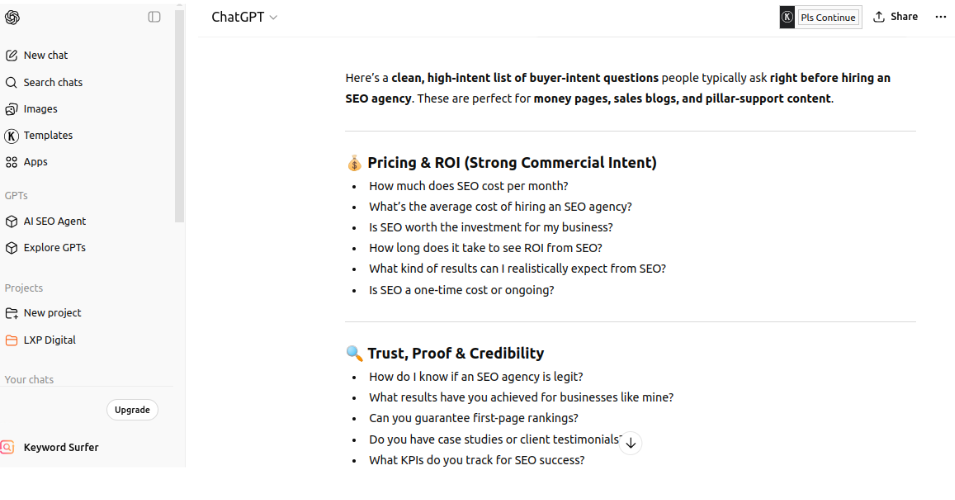
AI helps you move faster from “ideas” to “qualified traffic.” Instead of guessing what to write, you can use AI to expand, cluster, and prioritize topics that map to customer intent.
Use AI for research in a way that’s ranking-safe:
- Start with real offers (services you actually deliver).
- Use AI to support AI keyword research by generating:
- Buyer-intent questions people ask before hiring an agency
- Related subtopics that support one main page
- Pain points by industry (without inventing fake stats)
- Buyer-intent questions people ask before hiring an agency
Then, validate with SEO tools and real SERP observation.
A practical workflow (what to do this week):
- Make a list of your money pages: SEO, PPC, SMM, web design/development, lead generation
- For each service, create:
- 1 pillar page (service)
- 3–6 support blogs answering common “should I / how do I / what does it cost / what mistakes” questions
- 1 pillar page (service)
How Can AI Help You Create Pages Google Can Understand And Trust?
AI helps you structure content like an answer engine, so both Google and LLMs can extract it cleanly. Competitors talk about GEO and AI visibility, but most don’t give business owners a usable writing structure.
A page structure that works (and why):
- Lead with the answer (1–2 sentences)
- Add a short “what this means” explanation
- Follow with scannable bullets:
- steps
- checklists
- examples
- steps
- Close with “next step” guidance (without hype)
AI can support:
- Outlines that match intent
- Drafting sections you’ll refine
- Rewriting for clarity and reading level
- Creating consistent definitions across your AI digital marketing strategy
How Can AI Help You Improve On-Page Performance Without Keyword Stuffing?
AI is most useful for coverage and clarity, not for forcing keywords. Your goal is to cover the topic fully, using natural language and making the page easier to scan.
Here’s what to optimize on-page (with AI support):
- Title + meta description drafts
- AI can propose variations; you pick the one that matches intent.
- AI can propose variations; you pick the one that matches intent.
- Section clarity
- Ask AI: “What questions are implied by this query that I haven’t answered yet?”
- Ask AI: “What questions are implied by this query that I haven’t answered yet?”
- Topical completeness
- Ask AI to list “must-cover subtopics,” then compare against competitors.
- Ask AI to list “must-cover subtopics,” then compare against competitors.
- Internal linking suggestions
- AI can propose anchors; you choose links that actually exist on your site.
How Can AI Help You Find And Fix Technical Issues Faster?

AI helps you prioritize technical fixes that block rankings. Most businesses lose traffic because of slow pages, broken internal links, weak indexing, or messy site architecture, especially after redesigns.
Use AI in technical SEO like a triage assistant:
- Turn audit exports into prioritized fix lists
- Generate “developer-ready” tickets:
- What’s wrong
- Why it matters
- What “done” looks like
- What’s wrong
- Create QA checklists for new pages and site updates
How Can AI Help You Earn Authority Signals That Influence Rankings?
AI can’t “create trust,” but it can help you build the assets that earn it. Authority is built when your site consistently publishes useful content, earns mentions/links, and proves expertise through clarity and specificity.
Use AI to support authority-building work:
- Identify:
- partnership pages
- directories
- industry publications
- local community opportunities (Canada-specific)
- partnership pages
- Draft outreach emails (you personalize)
- Turn one strong article into multiple assets:
- a short LinkedIn post
- a checklist PDF
- a mini case-study format template
- a short LinkedIn post
What to avoid (especially with AI content):
- Publishing lots of near-duplicate articles
- “Me too” pages with no examples, no steps, no point of view
- Hiding service details behind vague marketing language
What Should You Measure To Prove It's Working?
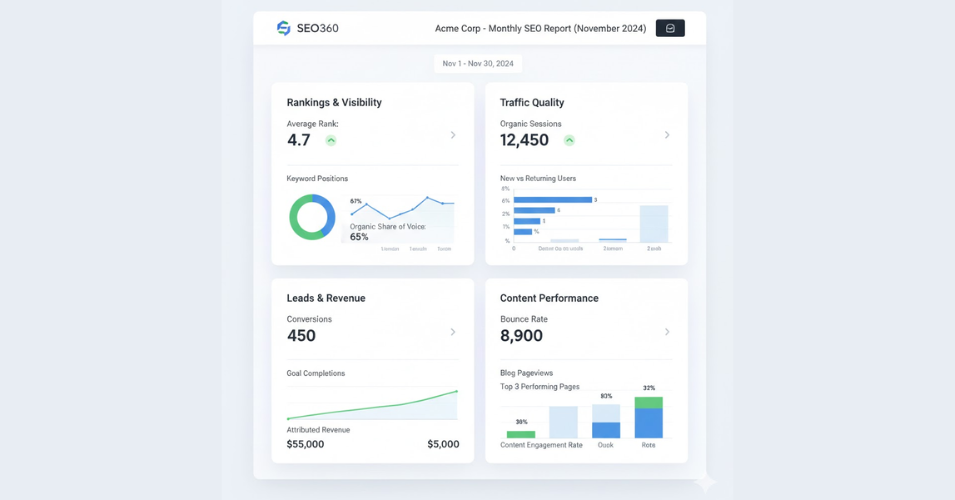
Track outcomes that connect rankings to growth, not just impressions. A simple monthly scorecard for businesses:
Rankings & visibility
- Primary and secondary query movement (especially long-tail questions)
- Pages entering the top 10/top 3
Traffic quality
- Organic sessions to service pages
- Blog → service page click-through rate
Leads & revenue
- Form fills / calls from organic traffic
- Assisted conversions (organic as first or middle touch)
Content performance
- Which Q&A sections drive featured snippet-like behavior (high scroll + time on page)
- Which internal links are getting clicks (so you double down on the right journeys)