

Most teams that tried AI content marketing in 2023 ended up with two outcomes: a graveyard of 200 generic blog posts that ranked for nothing, or a Google penalty for low-quality content. By 2026 the playbook has changed. The teams winning now use AI to handle the work that does not need a human, and keep humans on the work that does. The result is 8-10x more content output without the quality cliff.
This guide walks through how AI content marketing actually works in 2026. The tools to use. The workflow that scales. The mistakes that kill rankings. And how to keep your brand voice intact when AI is doing half the writing.
What AI Content Marketing Actually Means Now?
Two years ago, AI content meant typing a prompt into ChatGPT and publishing whatever came out. That approach is dead. Google’s helpful content system pulls down sites that publish AI-generated filler faster than it indexes them.
The modern definition is different. AI content marketing in 2026 is a workflow where AI handles research, briefs, first drafts, optimization, and distribution — while humans handle strategy, original opinions, fact-checking, and the parts of writing that carry your point of view. The output reads like your team wrote it because in a real sense, your team did.
If you want the broader frame for how this fits with paid ads, social, and SEO, our complete guide to AI digital marketing sits above this post and covers the full stack.
The 6-Stage AI Content Workflow That Works
Here is the workflow we use across client accounts in 2026. Each stage has a clear handoff between AI and human.
Stage 1 — Topic research and clustering. AI tools cluster keywords, identify content gaps against competitors, and produce a content calendar in hours instead of days. The AI side of this is covered in detail in our piece on AI for keyword research and search intent.
Stage 2 — Brief generation. AI scrapes the top 10 SERP results for a target keyword, extracts every H2, every entity, every FAQ, and produces a content brief. A senior editor used to spend 2-3 hours on this per article. AI does it in 8 minutes.
Stage 3 — First draft. AI writes a structured first draft from the brief. The output is usually 60-70% of the way to publishable. It has the right headings, the right facts, the right structure. What it lacks is the parts that matter most — original examples, opinions, and the voice that makes content sound like a person wrote it.
Stage 4 — Human rewrite. A writer takes the AI draft and rewrites 30-40% of it. They add real client examples, replace generic statements with specific ones, insert opinions where the AI was non-committal, and rewrite any section that reads like a textbook. This is the step most teams skip — and the reason most AI content fails.
Stage 5 — Content optimization. AI tools score the final draft against the SERP benchmark and flag missing entities or sections. The writer makes targeted edits where the score is weakest. This step takes 20-30 minutes per article and adds real ranking power.
Stage 6 — Distribution. AI repurposes the published article into 5-10 social posts, an email summary, and short-form video scripts. One blog post becomes a week of content across channels.
Where Most Teams Get AI Content Marketing Wrong?
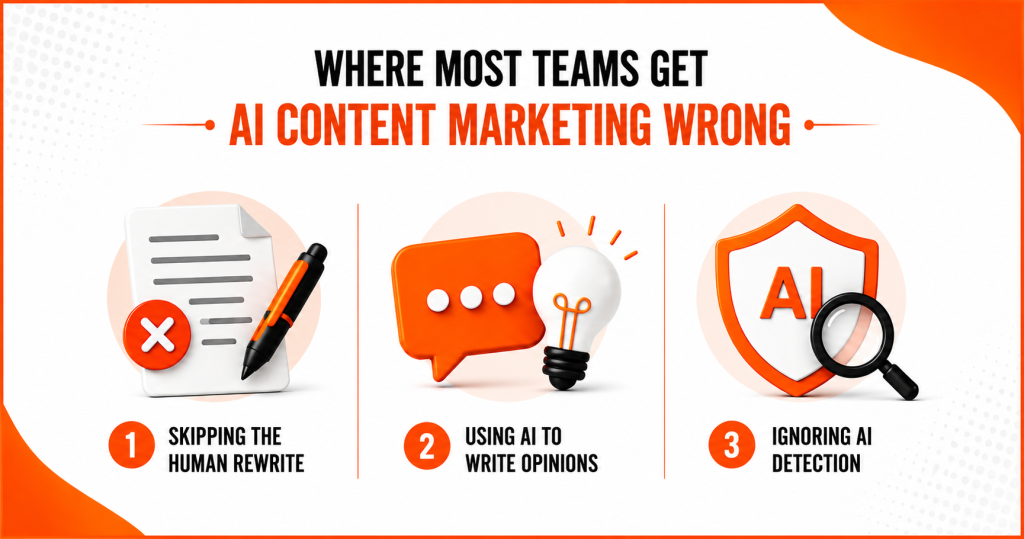
Three mistakes show up over and over.
Mistake 1: Skipping the human rewrite. Publishing AI output as-is gets you ranked for nothing and risks a helpful content system penalty. The rewrite is the difference between content that ranks and content that sits unindexed in Google Search Console.
Mistake 2: Using AI to write opinions. AI is great at structuring information. It is bad at having a point of view. When your content reads like every other article on the topic, it is because no human added their actual take. Original opinions are what Google’s helpful content system rewards.
Mistake 3: Ignoring AI detection. Google does not penalize AI content directly, but readers and AI detection tools do flag obvious AI patterns. If your content is going through editorial review or being published on third-party sites, AI detection matters. Our guide on detecting AI-written content and plagiarism covers the patterns to watch for.
The Tools Worth Paying For in 2026
The AI content marketing tool stack has consolidated. You do not need 12 tools. You need 3 or 4 that work well together.
- A research and clustering tool — Surfer, Frase, Clearscope, or the AI features inside Ahrefs / SEMrush.
- A writing assistant — Claude, GPT-5, or Gemini for first drafts. Pick one and learn its strengths.
- A content optimizer — usually the same tool as #1, used at the drafting stage.
- A distribution tool — Repurpose.io, ContentStudio, or in-house automations for cross-platform publishing.
How to Keep Brand Voice When AI Writes Half Your Content
This is the part most teams worry about and the easiest part to solve. Brand voice is a set of rules, and AI tools handle rules well.
Build a one-page voice document. Include the words you use, the words you never use, sentence length preferences, tone calibration (formal vs casual, expert vs friendly), and 3-5 example paragraphs from past content that hit the voice exactly right. Paste this into every AI prompt at the top. The output will sound 80% like you on the first draft.
The remaining 20% comes from the human rewrite stage. A writer who knows the brand catches the AI patterns the prompt missed. Together, prompt-level voice rules and a human pass produce content that even your most picky reader will not flag as AI-generated.
For the algorithm side of how AI is reshaping what gets rewarded in search results, our deep dive on how AI improves search rankings covers the ranking signals that have changed since 2024.
What This Means for Your Content Strategy?
If you publish 4 blog posts per month, you can publish 12-16 with the same team and budget once the workflow is set up. The first 30 days of building the workflow are slower than your current process. By day 45, output doubles. By day 90, it triples.
The teams who win with AI content marketing in 2026 are not the ones generating the most content. They are the ones with the cleanest workflow, the strongest brand voice prompts, and the discipline to do the human rewrite on every piece. AI is the lever. Editorial standards are the fulcrum.