Social media teams in 2026 do not look like social media teams from 2023. The work is the same — content, scheduling, replies, analytics, paid amplification — but the way the work gets done has been rewritten by AI. A single social media manager today can run what used to take a team of four. That is good news if you build the workflow right. It is bad news if you bolt AI tools onto your existing process and expect magic.
This guide breaks down how AI handles social media marketing in 2026. The tools that actually save time. The tasks AI does better than humans. The tasks where AI quietly tanks your engagement. And how to build a workflow that produces 5x more output without making your account look bot-run.
What AI Social Media Marketing Looks Like Right Now?
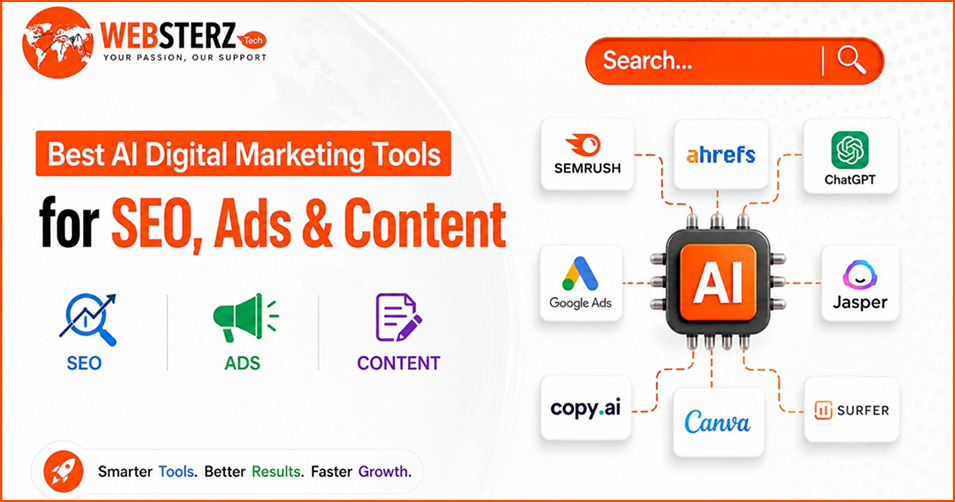
Three categories of AI tools now run inside almost every social account.
Category 1 — Content generation. Tools like Buffer AI, Canva AI, and ChatGPT-powered post writers produce captions, hashtag sets, image variations, and short-form video scripts on demand. A month of content that used to take 4-5 hours of brainstorming now takes 90 minutes of editing.
Category 2 — Scheduling and optimization. AI inside Hootsuite, Later, Sprout Social, and Meta’s own scheduling tools picks the best posting time for each platform and audience based on past engagement data. The old practice of posting at 9am because someone read it in a 2019 blog post is gone.
Category 3 — Analytics and listening. AI now reads through hundreds of comments, DMs, and mentions, tags sentiment, identifies recurring questions, and surfaces themes that humans would miss. What used to be a weekly manual review is a real-time dashboard.
For the wider picture of how AI fits across SEO, ads, content, and social, our complete guide to AI digital marketing covers the full landscape.
AI Content Generation for Social Media: What Works
AI is good at three social media content tasks. It is bad at one. Knowing the split saves you from publishing content that hurts your account.
Where AI wins
- Caption variations — give AI one core message, get 10 caption versions for testing across platforms.
- Hashtag research — AI suggests platform-specific hashtag sets based on actual current usage, not 2022 lists.
- Repurposing — a single blog post turns into 8 LinkedIn posts, 12 tweets, 4 carousels, and 6 short video scripts in under an hour.
Where AI fails:
Original opinions, hot takes, and content that requires a point of view. AI-generated thought leadership reads like a Wikipedia summary. It gets impressions and zero engagement. The accounts that grow on LinkedIn and X in 2026 are not the ones publishing the most AI content — they are the ones publishing the fewest, but with genuine perspective in every post.
This is the same pattern we covered in our piece on AI content marketing and how to scale content with AI — AI handles the volume, humans handle the voice. Social media follows the same rule.
AI Scheduling: Why Posting Time Still Matters in 2026
Posting time is one of the most over-debated topics in social media. The honest answer in 2026 is that AI scheduling tools have made it a solved problem — if you trust the data.
Modern AI scheduling looks at your last 90 days of post performance, segments by content type, day of week, and platform, then recommends optimal posting windows. The recommendations update weekly as the algorithm changes.
The mistake most teams make is sticking with a global posting schedule across all platforms. LinkedIn audiences peak at different times than Instagram audiences, which peak at different times than X audiences. AI scheduling lets you set platform-specific windows in 5 minutes — something that used to take a strategist hours of analysis.
Reality check: posting at the optimal time gives you a 15-25% engagement lift, not a 5x lift. The bigger wins still come from better content. But 15-25% adds up over 12 months.
AI Analytics: The Underused Half of Modern Social Media
Most teams use AI for content and scheduling and ignore the analytics side. That is where the highest-leverage gains hide.
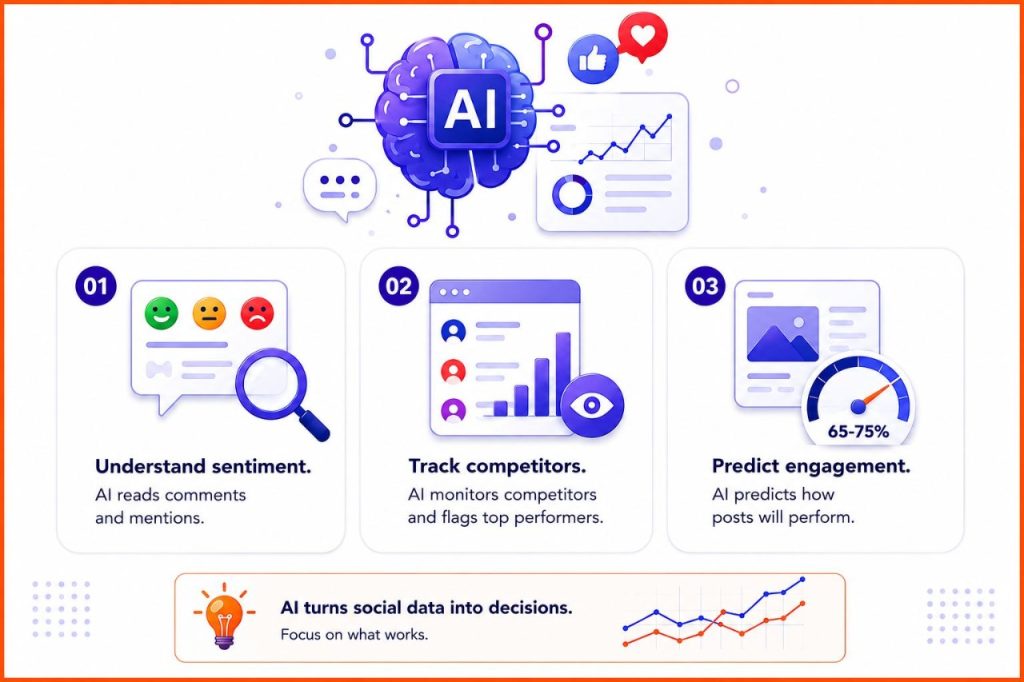
Sentiment analysis at scale.
AI now reads through 500+ comments, DMs, and mentions per week and tags every one as positive, neutral, or negative — with topic clustering on top. A skincare brand we work with caught a recurring complaint about packaging through AI sentiment tagging in week 2. It would have taken a human reviewer 6 weeks to spot the pattern.
Competitor monitoring.
AI watches 5-10 competitor accounts and flags posts that outperform their baseline by more than 200%. You see what is working in your niche in real time, not after the fact. The data is in every major social media management tool now.
Predictive engagement.
Newer AI features predict how a draft post will perform before you publish it, based on copy, hashtags, image style, and historical data from your account. The prediction is not perfect — usually 65-75% accurate — but it catches obvious flops before they go live.
The Workflow That Saves Hours Per Week
Here is the structure we deploy across client accounts in 2026.
- Monday — AI generates a content batch from the week's strategy brief. 30 minutes of human review and editing.
- Tuesday — Schedule the batch using AI-recommended time windows per platform. 20 minutes.
- Wednesday-Thursday — AI handles comment moderation triage, flagging high-priority replies for human response.
- Friday — AI generates an analytics report including sentiment, competitor moves, and top-performing posts. 30 minutes of human review.
Total: roughly 3 hours per week for an account that previously took 12-15 hours. The freed time goes into strategy, original content, and community building — the parts that actually grow accounts.
For deeper detail on how this connects with paid social spend and channel selection, our piece on organic vs paid social media sits alongside this one in the broader strategy conversation.
Where Most Teams Go Wrong With AI Social Media Marketing
Three patterns kill accounts faster than no AI at all.
Mistake 1: Publishing without editing. AI captions sound robotic by default. Audiences spot it in seconds. The unfollow rate on AI-generated content is 3-5x higher than human-written content in most niches.
Mistake 2: Using AI imagery for branded posts. AI-generated images have a generic feel that does not match brand-conscious accounts. Stick to AI for ideation, then commission real visuals.
Mistake 3: Treating analytics as a report instead of a feedback loop. The point of AI analytics is to change what you post next week, not to fill a slide for the monthly meeting. Most teams collect insights and never act on them.
If you want a full team running this workflow professionally across multiple platforms, our social media marketing service page covers what is included in monthly account management.