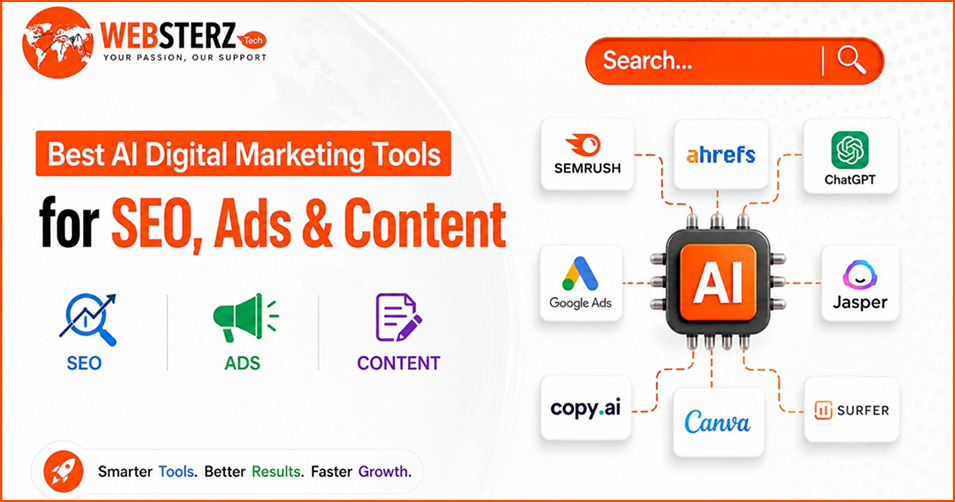
AI now runs most of the work inside Google Ads and Meta Ads. Smart Bidding, Performance Max, Advantage+ campaigns, automated audiences, AI-generated creative — five years ago this was experimental. In 2026 it is the default. The advertisers who learn how AI actually makes decisions inside these platforms get cheaper clicks and higher conversions. The ones who let AI run on autopilot waste 20-40% of their budget without knowing why.
This guide breaks down what AI does inside Google Ads and Meta Ads right now. What to automate. What to keep human. And the specific levers that separate profitable AI-driven campaigns from expensive ones.
What AI Actually Does Inside Google Ads and Meta Ads Now?
Three layers of AI are running in every modern ad account, whether you set them up or not.
Layer 1 — Bidding. Smart Bidding on Google and Advantage+ bidding on Meta use machine learning to set a bid for every single auction. The AI looks at device, time of day, location, search history, browser, and 60+ other signals — then bids more for the user most likely to convert and less for the user least likely. A human cannot match this speed or depth of signal use.
Layer 2 — Audience targeting. Performance Max and Advantage+ Shopping campaigns use AI to find new audiences your manual targeting would miss. The trade-off: you lose visibility into who is actually being targeted. You see results, not the audience map.
Layer 3 — Creative. Both platforms now auto-generate ad copy, images, and even short video from a few uploaded assets. The output is workable but generic. Brand-aware advertisers use AI creative as a baseline, then layer custom creative on top.
For the wider picture of how AI is reshaping every part of digital marketing, our pillar guide on AI digital marketing covers the full stack.
Smart Bidding in 2026: What Actually Works
Smart Bidding strategies have multiplied. Target CPA, Target ROAS, Maximize Conversions, Maximize Conversion Value, Enhanced CPC — every account has 5+ options. Most advertisers pick wrong.
The rule we use across client accounts: match the bidding strategy to your data, not your goal.
Under 30 conversions per month per campaign: Stay on Manual CPC or Enhanced CPC. AI bidding needs data to learn from. Below 30 conversions, Smart Bidding optimizes against noise and burns budget.
30-100 conversions per month: Use Target CPA. The AI has enough data to start hitting a cost-per-acquisition target reliably. Set the target 10-15% above your historical average so the algorithm has room to learn before tightening.
100+ conversions per month with revenue tracking: Move to Target ROAS or Maximize Conversion Value. These strategies optimize for revenue, not just leads. Most ecommerce accounts and high-ticket service businesses get their biggest wins by switching here.
If you are weighing whether to invest in ads at all versus organic, our breakdown of Google Ads vs SEO for service business growth sits next to this post in the bigger picture.
Performance Max and Advantage+: The Black Box Campaigns
Performance Max on Google and Advantage+ on Meta are the most AI-heavy campaign types ever launched. You upload assets and a budget. The AI handles placement, audience, creative selection, and bidding. The platform decides everything.
They can produce excellent results. They can also burn money silently. The difference is in how you set up the inputs.
What works in Performance Max
- Strong conversion tracking — every conversion event in GA4 and Google Ads, with accurate values.
- Audience signals — give the AI a seed audience to learn from, even though it can expand beyond it.
- High-quality asset groups — 10+ headlines, 5+ descriptions, 5+ images, ideally video. The AI tests combinations.
- Exclusion lists — branded search keywords, irrelevant placements, low-quality apps. The AI does not exclude unless you tell it to.
Without these inputs, Performance Max defaults to whatever traffic is cheapest, which is often whatever traffic is also useless.
AI Creative: What to Trust and What to Reject
Both Google and Meta now generate ad creative automatically. Responsive Search Ads on Google have always used AI to test headline combinations. The newer change is auto-generated ad copy from your landing page content, and AI-generated images for Display and Demand Gen campaigns.
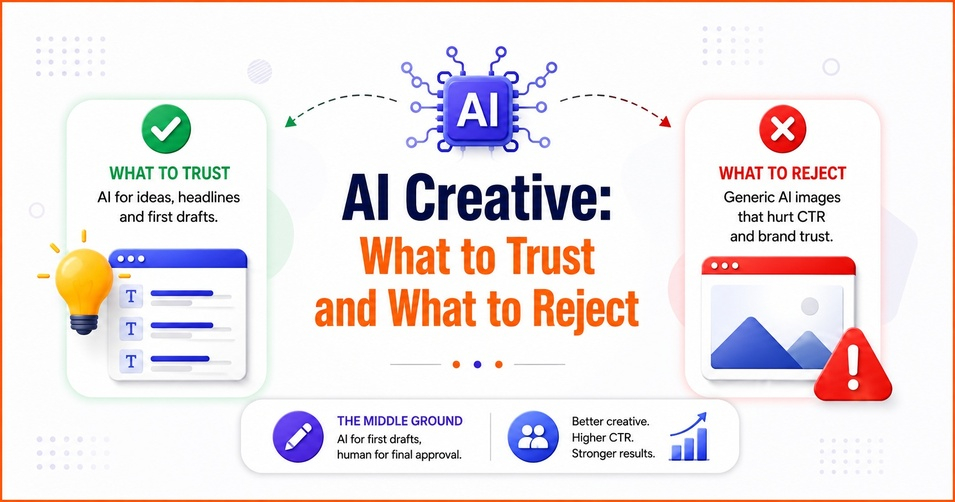
What works: using AI to generate the first 10 headline variations. The AI catches angles a copywriter would miss because it pulls from your landing page language directly.
What does not work: letting AI generate images for branded campaigns. The output looks generic, often gets flagged by reviewers in your audience, and lowers click-through rates. Custom imagery still wins on every brand-conscious account we manage.
The middle ground: AI for first drafts, human for final approval. This matches the pattern that works across every AI marketing workflow — covered in detail in our guide on AI for keyword research and search intent analysis, which sits one step earlier in the same pipeline.
How to Cut 30% of Wasted Ad Spend Using AI Audit Tools
Most accounts have 20-40% of budget going to clicks that will never convert. AI audit tools catch this faster than any manual review.
The audit looks at search term reports, placement reports, and audience reports — flagging patterns a human would take days to find. Common findings: 15-20% of search terms are irrelevant variations the AI bidding kept buying. 10-15% of Display placements are mobile apps with no conversion history. 5-10% of audiences are overlapping with branded traffic and being double-counted.
Once flagged, the fix takes 30 minutes. The savings show up the same week.
For a deeper look at how we apply this across PPC and Google Ads campaign management, the service page covers our full audit process and what is included in monthly management.
What This Means for Your Ad Strategy in 2026
AI in paid advertising is no longer optional. The accounts that resist Smart Bidding and Performance Max are losing 15-25% efficiency to the accounts that embrace them. But the accounts that turn AI on and walk away lose more.
The winning approach in 2026 is supervised automation. Let AI handle bid decisions, audience expansion, and asset rotation. Keep humans on conversion tracking accuracy, exclusion lists, creative direction, and account strategy. The combination beats either pure manual or pure AI every time.
Most teams overestimate what AI can do alone and underestimate what AI can do with one experienced operator overseeing it. The ratio that works: 80% AI execution, 20% human steering.
Our portfolio speaks for itself. We have worked with businesses across the USA and Canada and helped them grow. Want the same results? Let’s talk!
Frequently Asked Questions
At least 30 conversions per month. Below that, the AI optimises against noise. Use Target CPA at 30–100 conversions, and Target ROAS above 100.