 Manoj Kumar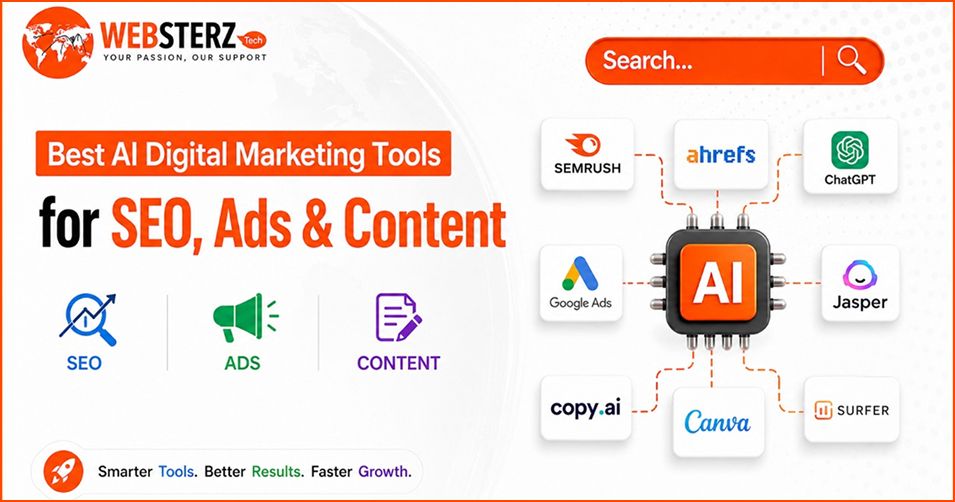
There are roughly 4,000 AI marketing tools on the market in 2026. Most of them are forgettable wrappers around ChatGPT and Claude with a different logo and a higher monthly fee. The handful that genuinely produce results across SEO, paid advertising, content marketing, and analytics are surprisingly few. This guide cuts through the noise.
These are the AI digital marketing tools we actually use across client accounts in 2026, organized by what each one does best. Pricing, use cases, and honest notes on where each tool falls short. No affiliate links, no paid placements — just what works.
Talk to our team about your AI marketing stack
The Best AI SEO Tools in 2026
SEO is where AI tools have matured the fastest. Three categories matter: keyword and content research, on-page optimization, and topical clustering.
- Surfer SEO — $89-$219 per month
Best for: content optimization against the SERP. Surfer scores your draft against the top-ranking pages for a target keyword and flags missing terms, entities, and structure. Strong workflow integration with Google Docs. Weakness: the score is a benchmark, not a guarantee. A 90/100 page can still fail to rank if the underlying content is shallow. - Frase — $45-$115 per month
Best for: content briefs from the SERP. Frase pulls the top 10 results for any keyword, extracts H2s, FAQs, and entities, and produces a brief in under 10 minutes. The brief output is consistently strong. The AI writer feature is mediocre — use the briefs, skip the writing. - Clearscope — $189+ per month
Best for: enterprise content teams. More expensive than Surfer or Frase, but the keyword research and content scoring are tighter. Recommended only if content is your primary channel and budget is not the constraint. - Ahrefs / SEMrush with AI features — $99-$499 per month
Best for: comprehensive keyword and competitor research. The newer AI features inside both platforms handle keyword clustering and content gap analysis well. If you only have budget for one tool in this category, pick the one your team already uses. The AI features sit on top of the data you already pay for.
For a deeper breakdown of how AI changes the SEO discipline beyond tool selection, our piece on AI SEO and how artificial intelligence improves search rankings covers the algorithm side.
The Best AI Tools for Paid Advertising
Most of the meaningful AI for paid ads lives inside Google Ads and Meta Ads themselves — Smart Bidding, Performance Max, Advantage+. Third-party tools layer on top to do what the platforms cannot.
- Optmyzr — $499+ per month
Best for: Google Ads optimization at scale. Automates audits, bid adjustments, and budget pacing across multiple accounts. Strong for agencies managing 20+ accounts. Overkill for a single-account advertiser. - AdEspresso — $49-$259 per month
Best for: Meta Ads creative testing. The AI handles A/B testing of headlines, images, and audiences at a scale most teams cannot match manually. Reports are clean enough to share with clients. - Madgicx — $55-$149 per month
Best for: Meta Ads automation and creative analysis. The newer creative scoring features help you understand which ad creative is actually carrying the campaign — useful when you have 50+ ads running. - Smartly.io — Enterprise pricing
Best for: large advertisers running across multiple platforms. Automated creative generation, audience expansion, and cross-channel optimization. Not for small budgets — typical clients spend $50K+ per month on media.
If you are still deciding which AI features inside Google and Meta to actually use, our guide on AI in paid advertising and Smart Bidding covers the platform-native AI features that often deliver more impact than third-party tools.
Get a free AI tool stack audit
The Best AI Tools for Content Marketing
Content tools split into two groups: AI writers and AI workflow tools. The writers get most of the attention. The workflow tools deliver most of the value.
- Claude / GPT-5 / Gemini — $20-$30 per month each
Best for: first drafts and structured content. Each has strengths. Claude handles longer-form content well. GPT-5 is strong at code and structured data. Gemini integrates tightly with Google Workspace. Pick one and learn its quirks rather than switching constantly. - Jasper — $49-$129 per month
Best for: teams that want guardrails. Brand voice training is solid. Templates for emails, ads, and landing pages save real time. Output quality is decent — closer to a junior writer than a senior one. Use as a starting point, not a finish line. - Notion AI — $10 per user per month
Best for: content teams already in Notion. Drafting, summarizing, and reformatting inside your existing workspace. The integration matters more than the AI quality — workflow friction kills most AI tool adoption. - Descript — $15-$30 per month
Best for: video and audio content repurposing. Transcribes podcasts and videos, then lets you edit them by editing the text. The AI features handle background noise, filler word removal, and clip selection. Underused by most marketing teams.
For a deeper breakdown of how to actually structure an AI content production workflow, our piece on AI content marketing and how to scale content with AI covers the 6-stage workflow that connects these tools.
The Best AI Tools for Analytics and Predictive Modeling
Analytics is the underrated half of the AI tool stack. Most teams pour budget into content and ad tools while ignoring the analytics layer that tells you which campaigns are actually working.
- Google Analytics 4 with AI insights — Free
Best for: most businesses. The AI-driven insights inside GA4 surface anomalies, predict customer lifetime value, and identify high-value audiences. Free is the right price. Most teams underuse it. - Mutiny — Enterprise pricing
Best for: B2B SaaS personalization. AI-driven website personalization that changes copy, images, and calls-to-action based on visitor signals. Strong lift on conversion rates when your traffic volume justifies the cost. - Triple Whale — $129-$1,200 per month
Best for: ecommerce attribution. AI-powered attribution modeling across Meta, Google, TikTok, and email. Essential after iOS 14 broke first-party tracking. Pricing scales with revenue.
How to Pick the Right AI Tools for Your Stack ?
More tools rarely produce better outcomes. The companies winning with AI tools in 2026 use 4-6 well-integrated tools, not 15 disconnected ones.
- Prioritize integration. A weaker tool that talks to your CRM beats a stronger tool that does not.
- Match the tool to the channel where you have the biggest opportunity — not where the trend is hottest.
- Budget for an operator to actually use the tool. The biggest reason AI tools fail is that nobody is running them.
- Try every tool for at least 30 days before committing. Most tools allow free trials. Most disappoint compared to the marketing page.
For the broader picture of how all these tools fit into a coherent strategy, our complete guide to AI digital marketing sits above this post and connects the tool selection to the channel strategy.
Which AI Tools to Skip in 2026?
Some categories of AI tools sound useful but consistently produce poor outcomes.
- AI image generators for branded marketing
DALL-E, Midjourney, and similar tools produce generic-looking imagery that hurts click-through rates on branded ads. Useful for moodboards and ideation. Not useful for final creative on accounts that care about brand. - AI SEO writers that promise to write entire articles
Articoolo, AI-Writer, and the dozens of similar tools produce content that Google's helpful content system penalizes faster than you can publish. Use AI for first drafts inside a workflow, not for end-to-end article generation. - Niche AI tools without integration
Tools that produce data your team cannot easily move into your CRM, your analytics, or your campaign manager are not worth the monthly fee. Integration matters more than feature checklists.
Ready to build the right AI tool stack? Book a strategy call
Frequently Asked Questions
Straight answers to the questions business owners ask us most about this topic.
What are the best AI digital marketing tools for SEO, ads, and content in 2026?
The best AI digital marketing tools in 2026 include Surfer SEO and Frase for SEO, Google Ads AI and Meta Advantage+ for paid advertising, GPT-based tools for content creation, and Google Analytics 4 for performance tracking.
How many AI marketing tools should a business use?
Most businesses get the best results using 4–6 AI digital marketing tools that are well-integrated, rather than managing too many disconnected platforms that reduce efficiency.
Are AI tools effective for improving SEO and paid ads performance?
Yes, AI tools improve SEO and paid ads by automating keyword research, optimizing content, and enhancing bidding strategies. However, results depend on how well the tools are implemented and managed.
Which AI digital marketing tools should you avoid in 2026?
AI tools that promise fully automated content creation, generic image generation for branding, or lack proper integration with your marketing stack should be avoided, as they often deliver poor results.