 Manoj Kumar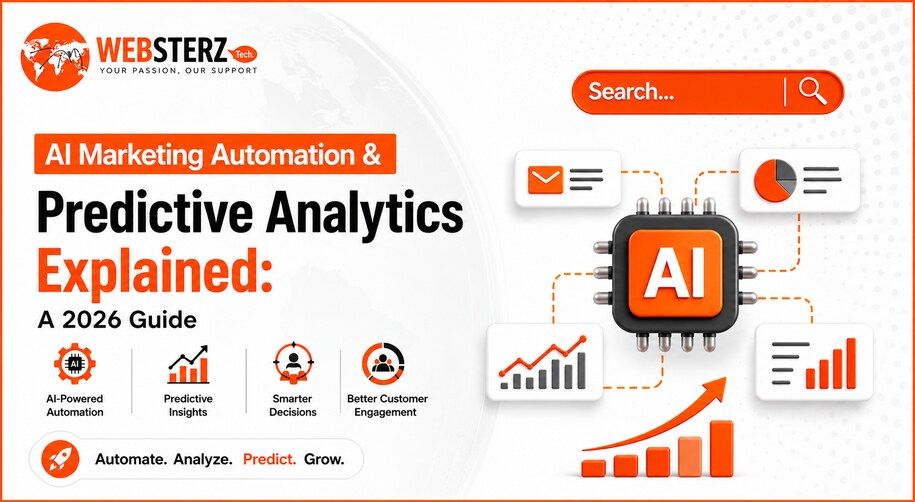
Marketing automation has existed for 20 years. It used to mean a series of if-this-then-that rules — if someone opens an email, send them another email three days later. Useful, but rigid. AI changed that. The 2026 version of marketing automation makes decisions based on prediction, not rules. Predictive analytics forecasts which leads will buy, which customers will churn, and which campaigns will outperform — usually with 70-85% accuracy. The combination of automation plus prediction has quietly become the single biggest productivity gain in modern marketing.
This guide breaks down how AI marketing automation and predictive analytics actually work in 2026. The platforms that matter. The predictions that hold up. The workflows that produce real revenue. And the mistakes that turn automation into expensive noise.
Talk to our team about AI marketing automation
What Has Changed in Marketing Automation Since 2023?
Three shifts define the current state of AI marketing automation.
- Shift 1 — From rules to predictions
Old automation: if someone visits the pricing page, add them to a sequence. New automation: predict the likelihood that someone will buy in the next 30 days based on 200+ signals, then route them into the right sequence automatically. The system decides, not the marketer. - Shift 2 — From single-channel to cross-channel orchestration
AI now coordinates email, ads, SMS, social, and website personalization as a single system. A lead who opens an email also sees a matching retargeting ad on Instagram and a tailored homepage banner — all triggered by one event. - Shift 3 — From historical reporting to real-time prediction
Analytics used to tell you what happened last quarter. Predictive analytics now tells you what will happen next quarter, with confidence intervals. Marketing teams plan against forecasts, not just past performance.
For the full picture of how AI is reshaping each digital channel, our complete guide to AI digital marketing sits above this post and ties it all together.
What Predictive Analytics Actually Predicts (And How Well)?
Predictive analytics is a broad term. In marketing, four predictions matter most.
- Lead scoring
AI models predict the probability that a lead will convert within a defined window. Accuracy ranges from 70-85% on accounts with clean CRM data. The output replaces gut-feel lead scoring with math. Sales teams stop chasing tire-kickers and focus on the 20% of leads driving 80% of revenue. - Churn prediction
For subscription businesses, AI flags customers showing early churn signals 30-60 days before they cancel. The accuracy is good — typically 75-85% — and the lift from acting on these signals is significant. Saving a customer costs 5-10x less than acquiring a new one. - Customer lifetime value forecasting
AI predicts what each customer will be worth over 12-24 months based on their first 30 days of behavior. Marketing teams use this to set acquisition cost ceilings per segment. A customer predicted to spend $5,000 lifetime can justify a $400 acquisition cost. A customer predicted to spend $200 cannot. - Campaign performance forecasting
Newer models predict how a campaign will perform before launch, based on creative, audience, and historical patterns. Accuracy is 60-75% — useful enough to kill obvious flops, not reliable enough to replace testing.
The AI Automation Stack That Actually Works
There is no single AI marketing automation platform that does everything well. Most companies use a stack of 3-4 tools that talk to each other.
- A CRM with AI built in — HubSpot, Salesforce, or Pipedrive with AI add-ons. This is the system of record.
- A marketing automation platform — Klaviyo for ecommerce, ActiveCampaign or Marketo for B2B. This runs the campaigns.
- A predictive analytics layer — built into the CRM or added through tools like Mutiny or 6sense for B2B.
- A customer data platform — Segment, RudderStack, or similar. This unifies data across the other three tools.
Setup takes 4-8 weeks for a mid-size company. The first 4 weeks are about getting data flowing cleanly between systems. The next 4 weeks are about building the first 5-10 automated workflows. After that, you add workflows monthly as patterns become clear.
Get a free marketing automation audit
Automation Examples That Produce Real Revenue
Here are four automation workflows we deploy across client accounts that consistently pay for themselves within 60-90 days.
- Lead-to-sales handoff with AI scoring
Every inbound lead is scored within 60 seconds of form submission. Scores above 80 trigger an immediate sales outreach. Scores 50-80 enter a nurture sequence. Scores under 50 enter a long-cycle education flow. Sales teams stop sorting leads manually. Conversion rates from lead to sales call typically rise 30-50%. - Cart abandonment with dynamic incentives
For ecommerce, AI decides whether to offer no incentive, a 10% discount, or free shipping based on the customer's price sensitivity and lifetime value prediction. High-value customers get nothing because they will buy anyway. Price-sensitive customers get the discount. The discount budget gets spent where it actually changes the outcome. - Cross-channel campaign orchestration
When AI bidding identifies a high-value audience inside Google Ads or Meta Ads, that audience gets matched into the email system for a coordinated nurture send. Inside our blog on AI in paid advertising and Smart Bidding , we go deeper on how AI inside ad platforms decides which audiences to target — the same logic feeds these cross-channel workflows. - Re-engagement with churn prediction
When AI flags a subscription customer as likely to churn, an automated sequence kicks off — personalized email, retargeting ad, sometimes a phone call from customer success. Save rates of 40-60% are typical when the system catches churn signals early. The email side of this workflow is covered in detail in our piece on AI email marketing and customer personalization at scale.
Where AI Marketing Automation Goes Wrong?
Three patterns kill the ROI faster than anything else.
- Mistake 1: Automating broken processes
If your current manual lead handoff is messy, automating it just makes a messy process happen faster. Fix the underlying workflow first. Then automate. Teams that skip this step end up with sophisticated systems delivering bad outcomes at scale. - Mistake 2: Trusting predictive models without testing
Every predictive model has assumptions baked in. A churn model trained on last year's data may not predict next year accurately if your product or market changed. Sample predictions and verify them against actual outcomes monthly. If accuracy drifts below 70%, retrain. - Mistake 3: Over-automating customer touch points
Customers spot fully automated interactions and resent them. The accounts that win in 2026 use AI to handle decisions and signals, but keep humans on the final touch — the sales call, the customer success check-in, the high-stakes email. AI scales the system. Humans close the relationship.
For a broader take on how AI fits into the wider marketing operations picture, our existing piece on how AI can help your marketing covers the strategic foundations this post builds on.
What This Means for Your Marketing Operations in 2026?
AI marketing automation in 2026 is no longer a competitive edge. It is the baseline. Companies running pure manual workflows are losing efficiency to competitors at a rate that compounds every quarter.
The right approach: invest 4-8 weeks in setup, focus the first phase on the 3-4 highest-leverage workflows, measure outcomes religiously, and expand from there. Most companies see ROI by month 3 and full payback by month 6. The compound benefit kicks in around month 12, when the system has enough data to make accurate predictions across every customer touchpoint.
The biggest mistake is waiting. The teams that started in 2024-2025 already have two years of clean data feeding their predictive models. That data advantage is hard to close once you fall behind.
Businesses across the USA and Canada trust us to deliver results. Our portfolio is proof of that. Think we can help you too? Let’s find out together!
Ready to build your AI marketing automation stack? Book a strategy call
Frequently Asked Questions
Straight answers to the questions business owners ask us most about this topic.
How accurate is predictive analytics in marketing?
It depends on the model. Lead scoring and churn prediction hit 70–85% accuracy on accounts with clean CRM data. Campaign performance forecasting is lower — around 60–75% — useful for killing obvious flops but not a replacement for testing.
How long does it take to set up AI marketing automation?
Around 4–8 weeks for a mid-size company. The first four weeks focus on getting data flowing cleanly between tools. The next four build the first five to ten workflows. Most teams see ROI by month 3 and full payback by month 6.
What is the biggest mistake teams make with marketing automation?
Automating a broken process. If your manual lead handoff is already messy, AI just makes the mess happen faster. Fix the underlying workflow first — then automate.
Can AI replace human touch points in the customer journey?
No. AI handles decisions and signals well, but customers spot fully automated interactions and resent them. The winning approach is AI for routing and timing, humans for the final touch — the sales call, the check-in, the high-stakes email.